A coding agent asks to run a database command. A developer approves it and asks the tool to remember that decision. The command runs. The surprise comes later, when the saved approval, with a credential still in it, can become part of a Git commit.
The reporting question is where that extra copy appeared and which control could have stopped it. Our rule at Kushal Labs is to follow a claim until it changes a reader’s decision. Sometimes that produces a tool. Sometimes it produces a test that someone still needs to run. Apiiro’s investigation
When a signal earns an investigation
We look for specific events across specialist publications and reviewed public Instagram posts. Two independent Instagram accounts or three independent publishers covering the same development within seven days gets a topic onto the research desk. An outlet and its own Instagram account count as one. Three outlets can all be responding to the same underlying study, so the evidence still has to be traced back to its origin.
- Evidence, up to 3 points and at least 2. The original material supports a narrowly stated claim.
- Impact, up to 3 and at least 2. The finding could change a developer’s or architect’s decision.
- Material change, up to 2 and at least 1. Something verifiable has changed since earlier coverage.
- Original contribution, up to 2 and at least 1. We can add an explanation, test, or artifact the reader can use.
At 8/10 or higher, with all four minimums met, we assign a dedicated investigation. The investigator checks what would disprove the working explanation, who is affected, what others have already tried, and whether a test could resolve the remaining question. A smaller verified development can run as a brief. A weak claim stays on watch. A previously covered story comes back when there is a material change.
The finished article has its own 9/10 publication bar. That review weighs accuracy, value to the reader, originality and presentation, with source, rights and delivery checks. The commissioning score measures whether a story deserves reporting time. Kushal Labs editorial standards
Case one — follow the credential into Git
Apiiro reported finding likely credentials in 1,122 of 104,185 public copies of Claude Code’s local settings file. Its study classified candidates using their format and context. Whether a credential still worked or had been used was a separate question. A 2025 issue already described the persistence mechanism. The November study added a count of how often the pattern appeared in the files it examined. Apiiro study · iTWire reporting · Earlier GitHub issue
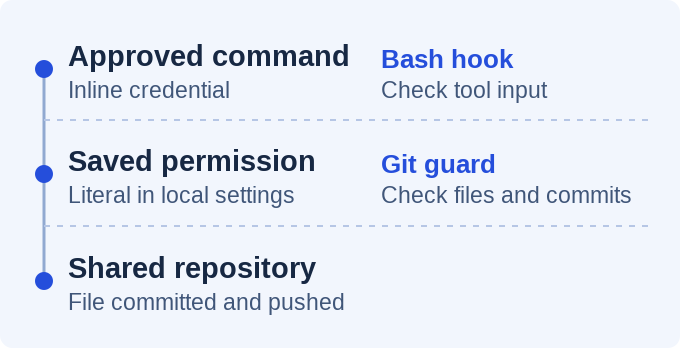
The initial command could have been authorized. Saving the literal command was a separate operation. Claude Code documents a Git exclude for the local file it creates. Git can still stage an ignored file when it is force-added, and an ignore rule leaves an already tracked file in the index. Anthropic also documents managed permissions that restrict local rule saving. Each control applies at a different point in the chain. Claude Code settings · Managed permissions · Git ignore behavior
Anthropic’s November 6 release addressed a separate Bash permission-check bypass and a worktree sandbox escape. A Claude Code team member said they were looking into how to prevent secrets from being retained. These are distinct engineering tasks, so a release that closes one path calls for a separate test of the saved rule. November 6 release · Team response
We released Agent Approval Guard to check two points we could test directly. Its Claude Code hook checks Bash tool input for selected inline credentials. Its Git checks reject local Claude settings, inspect shared settings and look through incoming commits. One test adds a fabricated credential in a commit and removes it in the next. The final tree passes and the commit-range scan still flags the earlier exposure. The release’s 11 synthetic tests passed on macOS and Linux. Open-source release · Public test run
What to do. Keep literal credentials out of commands, inspect staged files and incoming commits, and use broader scanners for transcripts and other artifacts. If a credential was exposed, revoke or rotate it before rewriting history. The guard covers specific Claude Code inputs and settings. Evidence for Codex or Google Antigravity would require checking what each client actually saves. GitHub incident guidance · Scope and cross-tool analysis
Case two — find out what actually got faster
METR’s assessment of AI research at Anthropic cleared our commissioning gate at 8/10. The specialist investigation started with the denominator. METR’s main analysis estimated that Anthropic’s internal benchmark index improved 1.9 times as fast after an October 2025 breakpoint. The estimate varied from 1.1 to 2.9 times under alternative scoring assumptions. The claim that AI drove most of the increase is a separate judgment, and Anthropic redacted much of the evidence METR found most informative. METR assessment and methods
That distinction changes what a team should measure. A new assistant might give a project an early jump. A sustained speedup would show up as a growing advantage across repeated cycles.
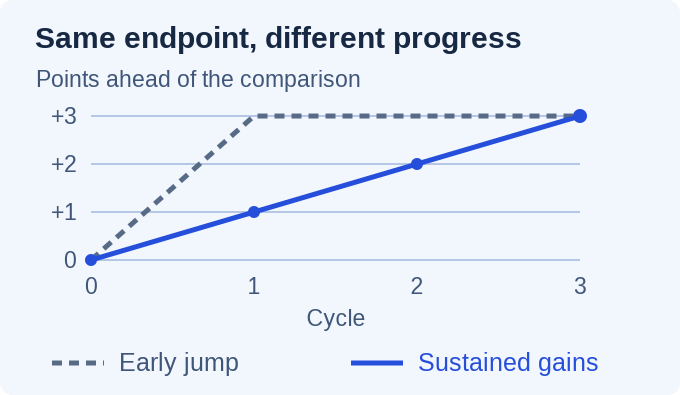
What to test. Pick one workstream, such as improving search relevance. Pair tasks from the same starting point and randomly assign the proposed assistant or the current workflow. Give both the same time and compute budget. Measure improvement on examples held back from development, and count review and rework alongside implementation time. Repeat across several cycles and keep unfinished tasks in the record. This is a proposed experiment for a smaller team. METR’s separate developer study describes how task selection and concurrent agent use can complicate this kind of measurement. METR developer study update · What an AI pilot should prove
What would change the story
For the credential case, a verified change to saved approvals would justify testing the same path again. For Anthropic’s research, a comparable assessment on harder tasks that separates AI assistance from staffing and compute would strengthen the causal claim. Those are two different follow-up triggers because the unanswered questions differ.
When you read a claim about an AI tool this week, try one check. Write down the decision the claim is supposed to change, then open the original source and see whether it measures the outcome you need. If you have a better source or a reproducible counterexample, send a correction.